Description
You want to make a cool robot, maybe a hexapod walker, or maybe just a piece of art with a lot of moving parts. Or maybe you want to drive a lot of LEDs with precise PWM output. Then you realize that your microcontroller has a limited number of PWM outputs!
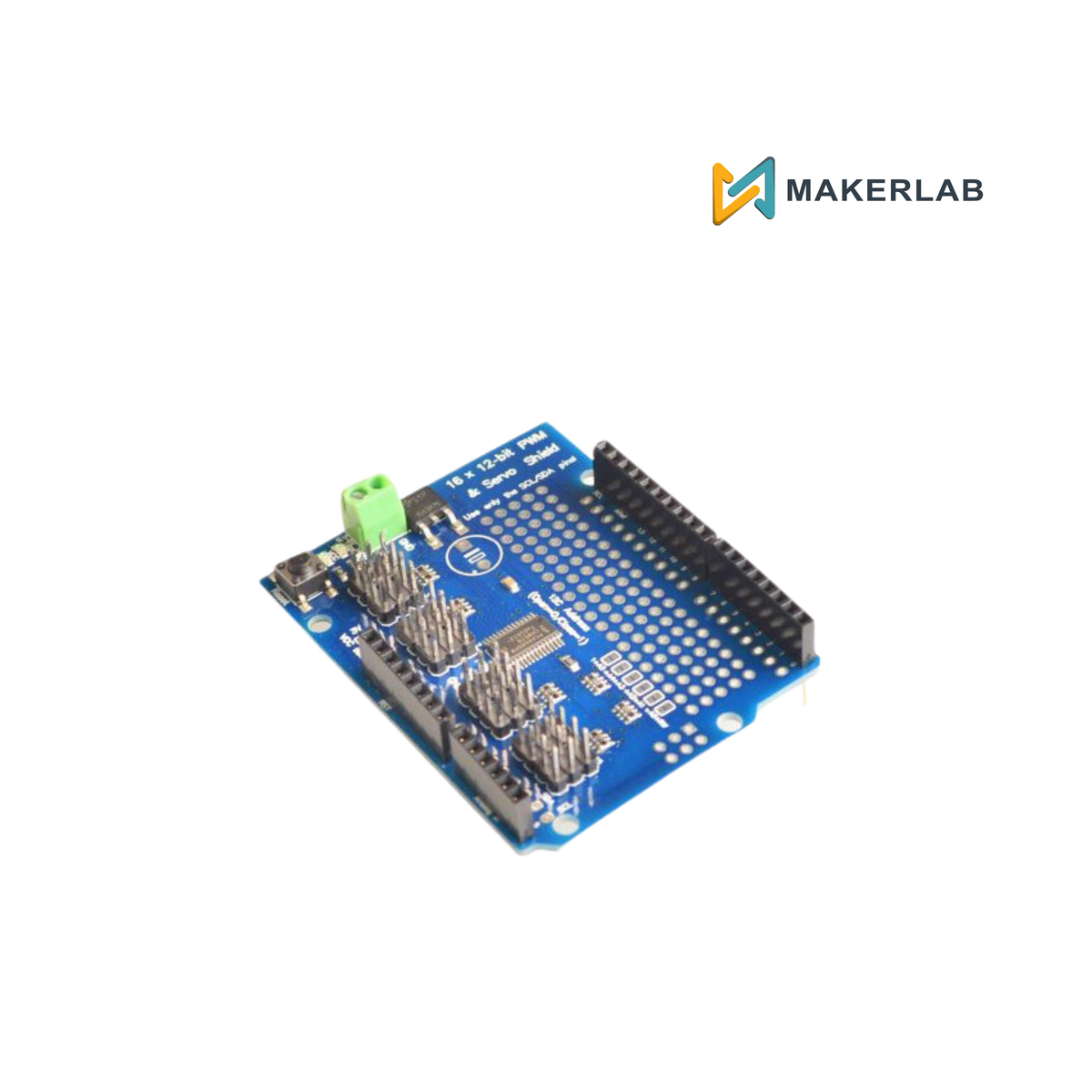
What now? You could give up, OR you could just get our handy PWM and Servo driver shield. It's now Arduino-ready and works with any Arduino that uses shields: Uno, Mega, ADK it's all good.
Using only two pins, control 16 free-running PWM outputs! You can even chain up 62 breakouts to control up to 992 PWM outputs.
Features:
- It's an I2C-controlled PWM driver with a built-in clock. That means that, unlike the TLC5940 family, you do not need to continuously send it a signal tying up your microcontrolle it's completely free running!
- It is 5V compliant, which means you can control it from a 3.3V microcontroller and still safely drive up to 6V outputs (this is good for when you want to control white or blue LEDs with 3.4+ forward voltages)
- 6 address select pins so you can wire up to 62 of these on a single I2C bus, a total of 992 outputs that's a lot of servos or LEDs
- Adjustable frequency PWM up to about 1.6 KHz
- 12-bit resolution for each output for servos, that means about 4µs resolution at 60Hz update rate
- Configurable push-pull or open-drain output
- Output enable pin to quickly disable all the outputs
Board Extras:
We wrapped up this lovely chip into a breakout board with a couple of nice extras:
- Terminal block for power input (or you can use the 0.1" breakouts on the side)
- Reverse polarity protection on the terminal block input
- Green power-good LED
- 3-pin connectors in groups of 4 so you can plug in 16 servos at once (servo plugs are slightly wider than 0.1", so you can only stack 4 next to each other on 0.1" header)
- "Chain-able" design
- A spot to place a big capacitor on the V+ line (in case you need it)
- 220-ohm series resistors on all the output lines to protect them, and to make driving LEDs trivial
- Solder jumpers for the 6 address select pins